






Nicolas Kanellopoulos, in his capacity as President of the Institute for Justice and Growth and Executive Director of the Institute for Privacy Law, Data Protection and Technology, of the EPLO European Public Law Organization, participated in and made a substantial contribution to the successful event on the topic “Governance and Data Anonymization: Safe Disclosure and Utilization of Public Data in the New Digital Era,” organized by the National Documentation Centre (EKT), by the Special Secretariat for Artificial Intelligence & Data Governance and the Hellenic Data Protection Authority.
The strong public turnout, with more than 800 participants from all over Greece, confirmed that issues of public data governance are now a pressing concern for public administration as well as for the scientific and business community. The quality of the dialogue that developed was one of the most notable features of the event.
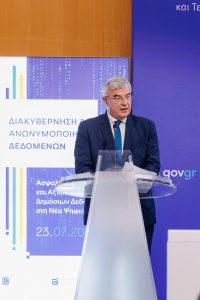

Mr. Kanellopoulos emphasized that the protection of personal data and the utilization of public data are not conflicting concepts and functions, but should instead be seen as two sides of the same coin: citizens’ trust in the rule of law. He further pointed out that today’s challenge is not whether we should utilize public data, but how we should do so — with what safeguards, institutions, and procedures.
Finally, he closed his address by referring to the three pillars of responsible governance. He first emphasized institutions, highlighting the need for clear rules, well-defined responsibilities, and effective oversight mechanisms. He then addressed technologies, specifically investment in Privacy-Enhancing Technologies (PETs), aimed at collecting and utilizing data while protecting the privacy of natural persons. Finally, he spoke about awareness-raising, noting the need for continuous training of DPOs, DGOs, public administration staff, and citizens themselves.
His approach helped foster a shared understanding that privacy protection and innovation are not conflicting goals, but can coexist within an environment of trust and security.